
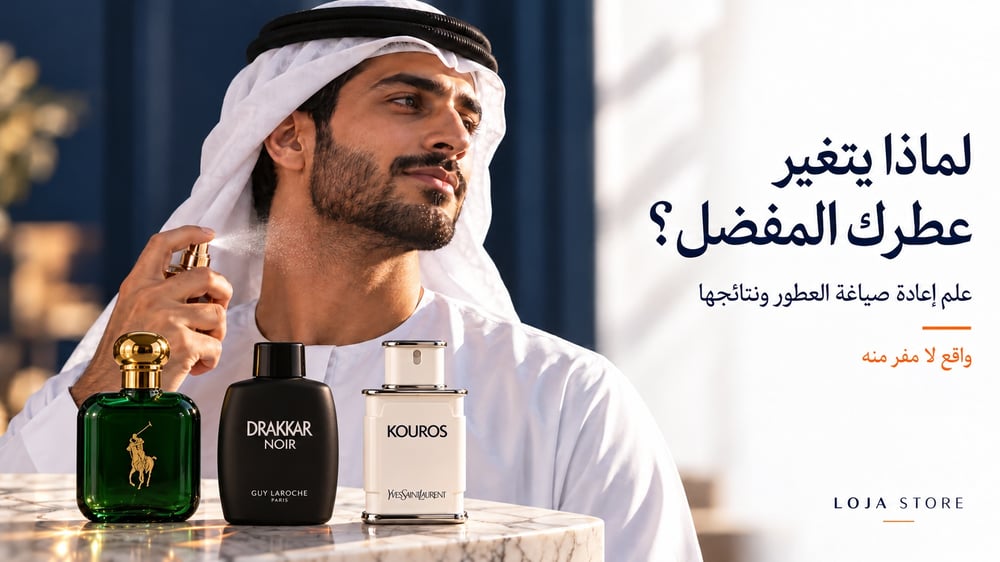
Why Does Your Favourite Perfume Change? The Science of Reformulation
You open a new bottle of a perfume you've worn for years and something feels different: a lighter opening, a softer base, or that deep earthy trail isn't quite what it was. You search, and find plenty of people asking the same question. Sometimes the answer is yes: the perfume has been reformulated.
Perfume reformulation is neither a conspiracy nor a cheat. It is the result of regulation, safety science and a natural world that keeps changing. This article explains why it happens, what actually changes in the scent, what we gained and lost, and why you shouldn't deprive yourself of a perfume you love while hunting for an 'old batch'.
What is perfume reformulation?
A fragrance formula is a living document, not something carved in stone. Reformulation means a house changes some ingredients or their proportions while keeping the name and overall character. Sometimes the goal is for the perfume to stay exactly the same despite changing materials; sometimes the law removes an ingredient entirely, and the perfumer rebuilds the effect it created with other materials.
Why perfumes get reformulated: four forces that never stop
1. Regulation: banned and restricted materials
In 2017 the EU banned three fragrance materials in cosmetics: HICC, sold as Lyral, atranol and chloroatranol. The decision followed a 2012 opinion of the Scientific Committee on Consumer Safety that identified them among the fragrance allergens causing the most contact-allergy cases. Products containing them could not be placed on the market from 23 August 2019, nor made available at all from 23 August 2021 [1].
Tellingly, the regulation itself justified the long transition by noting that fragrance reformulation is a lengthy process [1]. Lawmakers knew every perfume using these materials would need rebuilding.
In March 2022, Lilial, a pillar of lily-of-the-valley accords, joined the EU list of prohibited substances in an update covering materials classified as carcinogenic, mutagenic or toxic for reproduction [2]. Dozens of floral perfumes needed a replacement.
Then came wider disclosure: labels used to list 24 fragrance allergens by name, and a 2023 regulation added 56 more that must be listed above 0.001% in leave-on products, with older products allowed on the market until 31 July 2026 and on sale until 31 July 2028 [3].
2. IFRA Standards: an update roughly every three years
Alongside the law, the International Fragrance Association (IFRA) sets safety standards of three kinds: prohibition of a material, restriction of its amount or uses, and specification, such as purity criteria [4]. They rest on safety dossiers prepared by RIFM and reviewed by an independent expert panel, and they are compulsory for IFRA members, who produce around 80% of global fragrance volume [4].
Standards are issued in periodic amendments, normally every three years; consultation on the 52nd Amendment closed in June 2026. Under the latest published timelines, existing perfumes get 13 months to comply with a new prohibition and 28 months with a new restriction [4]. In other words, every few years the world's entire perfume library goes through a review.
Did you know?
Untreated oakmoss contains 2.4–2.9% atranol and 0.9–1.4% chloroatranol. Since 2008 IFRA has required each to stay below 100 parts per million in oakmoss extracts used in perfumery [5]. Today's perfumery oakmoss is a chemically cleaned material, not yesterday's moss.
3. Nature runs out, or changes
Some natural materials are simply no longer available as they were. Indian sandalwood (Santalum album) is listed as Vulnerable on the IUCN Red List, and in the state of Karnataka alone average annual output fell from about 2,288 tonnes in the early 1960s to about 62 tonnes in the first decade of the 2000s [6]. A perfume built on Mysore sandalwood in the 1970s cannot be made with the same material today.
Even available materials shift from harvest to harvest. Damask rose oil, for instance, varies with genotype, environment, climate, harvest timing, storage and processing [8]. So perfumers sometimes rebalance a formula to keep the perfume the same, not to change it.
4. Industry and supply
A supplier discontinuing a material, a sharp price rise, or production moving to a new plant are all practical reasons a house may adjust a formula. This side is rarely announced and is the least documented publicly.
Nishane Hacivat 50ml Extrait de Parfum
A modern chypre designed in the IFRA era: pineapple and grapefruit over cedar and oakmoss. Living proof that 'cleaned' oakmoss still builds a rich chypre base in skilled hands.
What reformulation actually changes in the scent
Change doesn't hit every perfume equally. The families most affected are those built on restricted materials:
- Classic chypres and fougères: oakmoss gives them their damp, earthy depth. With atranol reduced in the material itself, perfumers had to rebuild that effect with blends.
- Lily-of-the-valley and sheer white florals: after the Lilial ban, that dewy, watery effect is built with other molecules, so its 'freshness' may differ slightly.
- Creamy sandalwood scents: with Indian sandalwood scarce, the milky woody effect now comes from other sources and synthetics, with differences a trained nose can pick up.
Reformulation doesn't always eliminate the problem either. In a study of 15 people allergic to oakmoss, 8 reacted to the low-atranol version in a repeated-use test, versus 11 to the untreated one [5]. Reformulation lowers the risk without removing it, which is why reviews continue.
Creed Green Irish Tweed 100ml
A classic green fougère: lemon, mint, geranium and lavender over oakmoss. A family whose balance rests on moss, living on today in a formula that meets current safety standards.
The results: what we gained and what we lost
Material | What changed | Gain | Cost |
|---|---|---|---|
Oakmoss | 100 ppm cap on atranol/chloroatranol since 2008; EU ban 2019–2021 | Less exposure to top allergens | Rebuilding the classic chypre base |
Lyral (HICC) | EU ban 2019–2021 | One of the worst allergens removed | Some white florals rebuilt |
Lilial | EU ban since March 2022 | Reproductive-toxic material removed | Subtle shift in lily-of-the-valley scents |
Indian sandalwood | Severe scarcity, IUCN Vulnerable | Protecting a threatened species | Alternative sandalwoods and synthetics |
Allergen disclosure | From 24 to about 80 named on the label | More transparency for allergic users | Extra pressure on existing formulas |
The other side of restriction is innovation. Many pillars of modern perfumery were born from the search for new molecules, such as Hedione, developed in the early 1960s as an analogue of a key component of jasmine oil and first used in Dior's Eau Sauvage in 1966 [9]. Limits push chemistry forward, and a skilled perfumer turns boundaries into style.
Dior Eau Sauvage 100ml Eau de Toilette
A 1966 classic that made history with Hedione: citrus and herbs over oakmoss, vetiver and musk. Sixty years of updates, and its character is still clear from the first spray.
Why you don't need to chase the 'old batch'
Put regulation, rolling IFRA reviews and changing, scarce naturals together, and reformulation becomes inevitable for any perfume that lives long. Hunting for a specific batch code means denying yourself a perfume you love today for a memory that may not return as you imagine it:
- An old bottle is not a frozen copy: common fragrance ingredients such as linalool oxidise on contact with air into different products, some of them allergens [7]. A bottle opened or stored for years in Gulf heat may have drifted further from its original scent than the new formula has.
- You don't know its storage history: heat, light and air leave their mark, and none of it shows on the box.
- Your memory changes too: a scent tied to a happy period of life smells better in memory than it did.
- The current batch is the one the house stands behind today: safety-compliant, made with fresh materials and designed to keep the perfume's soul.
Collectors of vintage bottles have their own pleasure, and it's a fine taste. But enjoying a perfume doesn't depend on a bottle from a particular year. The perfume in your hands now is your real experience of it.
Guerlain Habit Rouge 100ml Eau de Parfum
One of Guerlain's oldest masculine orientals, with a base of vanilla, leather, benzoin and oakmoss. A scent that has lived through decades of updates, now offered in a richer eau de parfum.
Frederic Malle Portrait of a Lady 100ml
A generous dose of Turkish rose with incense, patchouli, sandalwood and benzoin: a modern perfume built from the start on today's materials and standards, proof that luxury doesn't need yesterday's ingredients.
How to handle reformulation wisely
- Judge on skin, hours later: real differences usually show in the base, not the first minute.
- Buy from a trusted source with fresh stock: a fresh original is closer to the house's design than a bottle of unknown storage.
- Keep perfume away from heat and light: in a Gulf summer, a wardrobe beats the car or the bathroom shelf.
- Don't hoard bottles out of fear of change: oxidation doesn't wait, and an open bottle is best enjoyed in use.
Frequently asked questions
Do perfume houses announce reformulations?
Rarely directly, because the aim is often for the perfume to stay familiar. What is disclosed is the list of allergens in the ingredient list on the box.
Does reformulation mean the perfume got worse?
Not necessarily. Some changes aim to keep the perfume the same as natural materials vary, and some remove materials proven to be among the worst allergens. The difference can be subtle or noticeable depending on the perfume.
Is an old bottle always better?
No. Perfume oxidises with air, heat and time [7], and an old bottle may have changed more than the modern formula.
Why do changes keep happening instead of once?
Because IFRA Standards are reviewed roughly every three years, laws are updated, and natural materials vary season to season [4] [8].
The bottom line
Perfume reformulation is the natural result of advancing safety science, changing nature and laws updated every few years. The details of your perfume may shift, but its soul stays in the hands of a house that knows it better than anyone. Enjoy your perfume today, and don't postpone the pleasure hunting for a bottle from the past.
At Loja we offer original luxury perfumes from fresh stock, with free shipping and thermally insulated packaging that protects your perfume from the heat on the way. Browse the collection at lojastoregt.com.
Sources
- Commission Regulation (EU) 2017/1410 (HICC, atranol, chloroatranol), EUR-Lex — https://eur-lex.europa.eu/legal-content/EN/TXT/HTML/?uri=CELEX:32017R1410
- Commission Regulation (EU) 2021/1902 (CMR substances incl. Lilial, applies from 1 March 2022), EUR-Lex — https://eur-lex.europa.eu/legal-content/EN/TXT/HTML/?uri=CELEX:32021R1902
- Commission Regulation (EU) 2023/1545 (fragrance allergen labelling), EUR-Lex — https://eur-lex.europa.eu/legal-content/EN/TXT/HTML/?uri=CELEX:32023R1545
- IFRA — IFRA Standards — https://ifrafragrance.org/initiatives-positions/safe-use-fragrance-science/ifra-standards
- Mowitz M., Svedman C., Zimerson E., Bruze M. (2014). Usage Tests of Oak Moss Absolutes Containing High and Low Levels of Atranol and Chloroatranol. Acta Dermato-Venereologica 94:398–402 — https://medicaljournalssweden.se/actadv/article/download/6373/9636/35799
- Arunkumar A.N. et al. (2016). The Population Decline of Indian Sandalwood and People's Role in Conservation. Springer — https://link.springer.com/doi/10.1007/978-3-319-31014-5_22
- Matura M. et al. (2005). Selected oxidized fragrance terpenes are common contact allergens. Contact Dermatitis 52(6):320–328 — https://portal.research.lu.se/en/publications/selected-oxidized-fragrance-terpenes-are-common-contact-allergens/
- Raeber J., Favrod S., Steuer C. (2023). Determination of Major, Minor and Chiral Components as Quality and Authenticity Markers of Rosa damascena Oil by GC-FID. Plants 12(3):506 — https://www.mdpi.com/2223-7747/12/3/506
- Davies E. The sweet scent of success. Chemistry World (Royal Society of Chemistry) — https://www.chemistryworld.com/feature/the-sweet-scent-of-success/1012496.article