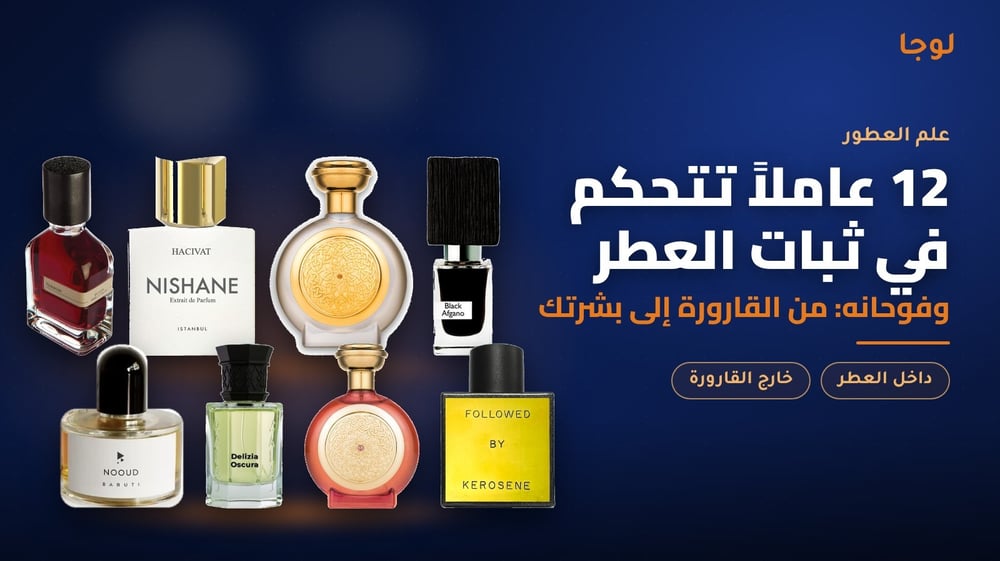
12 Factors That Control Perfume Longevity and Sillage
You wear the same perfume two days running: on the first, people ask about it; on the second, you think it has gone by noon. A friend wears the very same scent and it projects more on him than on you. The bottle didn't change, so what did? Perfume longevity and sillage aren't decided by the liquid alone. Half the story is inside the bottle; the other half is outside it, in your skin, your clothes, the weather, and even your own nose.
In an earlier article we explained the difference between longevity and sillage, and the odour value of molecules. Here we draw the full map: six internal factors in the formula, and six external factors beyond the liquid, with what research says about each.
Part one: internal factors, inside the bottle
1. The nature of each material and its vapour pressure
Every fragrance material has a vapour pressure, a natural tendency to escape into the air. Light materials such as citrus last around 15 to 30 minutes on skin, florals and spices around 3 to 4 hours, and heavy base notes more than 4 hours, according to an engineering review in Molecules [1]. So longevity starts with a simple question: what sits in the base?
2. Ingredient interactions: a perfume is a team
A material doesn't evaporate inside a perfume the way it does on its own. The evaporation equation for fragrance mixtures (a modified Raoult's law) combines three things: the material's vapour pressure, its share of the blend, and an activity coefficient that reflects its interactions with the other ingredients [1]. The same molecule can last longer in one formula and fade faster in another, depending on its companions.
The review gives a striking example from a computational model: when the base material in a particular mixture was changed from vanillin to tonalide, there was no region where tonalide was perceived; what you smelled instead was ethanol [1]. Choosing a heavy material, and how much of it, is a precise engineering decision, not just adding a smell.
3. Fixatives
A fixative is a slow-evaporating material that holds on to lighter ones. In a 2003 analysis, the evaporation pattern of a 12-ingredient mixture changed clearly when a musk fixative was added [3]. In a preliminary study from Pablo de Olavide University in Seville, Ambroxan reduced the loss of volatile compounds from a reconstructed perfume exposed to heat, compared with the same perfume without it [11].
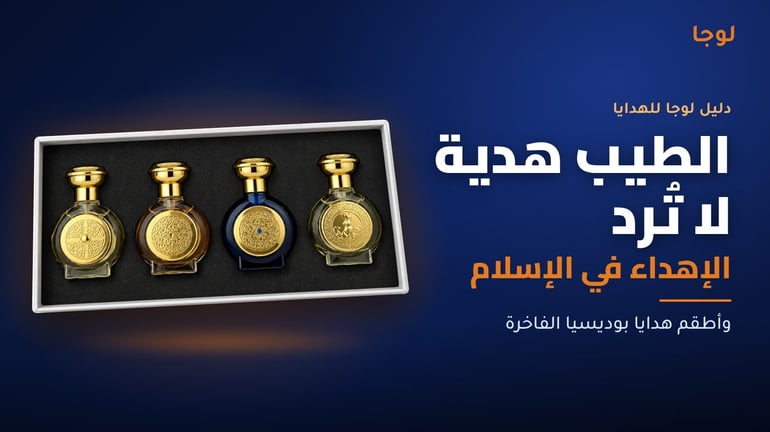
Boadicea the Victorious Amber Sapphire 100ml Parfum
A base rich in heavy materials: oud, vanilla, tonka, cedarwood and cashmeran, under a heart of rose, magnolia and mastic resin, in Parfum concentration. A clear example of longevity built from the base and its fixatives.
4. Concentration and perfume oil content
Concentration is the share of fragrance materials relative to the solvent. The higher it is, the more base molecules remain on skin once the alcohol has gone. Serious houses sometimes publish the figure: Amouage, for example, states a 20% oil concentration for Love Delight.
5. The solvent: alcohol that carries the scent, then leaves
Alcohol (ethanol) is the medium the fragrance materials are dissolved in, and it is the first thing to evaporate after you spray [1]. That's why the first seconds can feel sharp, and the true scent emerges once the alcohol leaves the fragrance materials behind on skin.
6. Ageing and maceration
Many houses let a perfume rest after blending so it can settle before bottling. Amouage, for instance, says Love Delight is aged for seven weeks: four weeks of maceration, then three of maturation. In the Seville preliminary study, an electronic nose and then human testers recorded a higher odour intensity in samples stored at 40 °C, which the researchers attributed to heat-driven maceration, while noting that perfume separates into phases at 50 °C [11].
Gift Set Amouage Love Delight Woman (100ml EDP + gel + lotion)
A house that publishes its numbers: 20% oil concentration and seven weeks of ageing. Ginger and rose water, then heliotrope, jasmine and rose, over vanilla and cacao. The matching gel and lotion also serve external factor nine below.
Part two: external factors, outside the bottle
7. Heat: skin temperature and the weather
When researchers study how perfume evaporates and is absorbed, they set their equipment to about 33 °C to mimic skin surface temperature [2]. The higher the temperature, the higher the vapour pressure and the faster materials evaporate: stronger projection at first, and a shorter life for the light notes. That's why the same scent sounds louder but runs shorter in a Gulf summer than on a winter night.
8. Air and wind
The same research notes that evaporation from skin depends on external factors including temperature, wind and surface properties [2]. A room with air conditioning blowing straight at you, or a windy day in the desert, speeds a perfume's departure, while a warm, still space keeps it and makes its sillage clearer.
9. Your skin: hydration, oils and pH
Part of a perfume never evaporates; it is absorbed into the skin, and the two processes compete from the moment you spray [3]. Absorption itself is affected by skin hydration, water loss and temperature [2]. Evaporation speed is also influenced by skin type, dry or oily, and by pH [4]. That's why the same perfume lives longer on one person than another.
10. The surface: skin, fabric or hair
Heavy, less water-soluble molecules cling to fibres, including keratin fibres such as hair and wool [5]. The fabric itself changes the story: in a 2024 study on odour compounds from sweat, cellulosic fibres such as cotton showed lower amounts in the air above them than wool, nylon and polyester after 30 minutes, and after 24 hours polyester released the most [6]. A ghutra, a shemagh and an abaya are not the same surface when it comes to holding scent.
Boadicea the Victorious Oud Sapphire 100ml Parfum
Saffron, black pepper and ambrette, then oud, leather and osmanthus, over orris, sandalwood and styrax, in Parfum concentration. A base of heavy materials that finds an ideal surface in a ghutra or thobe, made for Friday scenting and the majlis.
11. Your own nose: adaptation and specific anosmia
Sometimes a perfume hasn't gone; your nose has simply stopped noticing it. In a classic study of olfactory adaptation, more than 50% of adaptation often occurred within the first two minutes, and recovery was faster than adaptation [7]. That's why people in the majlis can smell your perfume while you think it has left.
Some people can't smell certain materials at all. A study in Chemical Senses of 79 people confirmed a specific anosmia to the synthetic musk Galaxolide [8]. Another, of 32 people, found wide differences in sensitivity to 11 musks, with 18 cases out of 352 tests in which a person could not detect a given musk at all [9].
Did you know?
If your musky perfume feels like it doesn't last, it may be perfectly clear to the people around you while your nose is simply less sensitive to that particular musk [8][9].
Rotating between several perfumes during the week gives your nose a chance to recover its sense of each one [7].
Boadicea Bestsellers Gift Set (4 × 10ml)
Four Boadicea scents from different families: Blue Sapphire with saffron and oud, Complex 2020 with leather and frankincense, Valiant with orange blossom and vanilla, and Glorious with fruit and cardamom. Rotating between them through the week keeps each one vivid to your nose.
12. Storage: light, heat and air
A perfume changes in its bottle if stored badly. Terpenes common in citrus and lavender, such as limonene and linalool, oxidise easily on exposure to air and turn into other compounds [10]. In the Seville study, light caused colour degradation in perfumes, and the researchers found that the essential oils themselves reduce the effectiveness of added UV filters [11].
Because heat is one of the biggest threats to perfume in the Gulf, at Loja we keep our perfumes in air-conditioned warehouses and pack every shipment with thermal insulation on its way to you, so your perfume arrives protected from the heat of the road, just as it left the warehouse.
Factor | Type | How it works | What to do |
|---|---|---|---|
Material nature | Internal | Heavy materials last over 4 hours, light ones minutes [1] | Read the base of the pyramid |
Ingredient interactions | Internal | A molecule behaves according to its companions [1] | Trust a well-built formula |
Fixatives | Internal | Slow the escape of lighter materials [3][11] | Look for musk, amber and resins |
Concentration | Internal | More oil means more base on skin | Choose Parfum or Extrait for longevity |
Solvent | Internal | Alcohol evaporates first [1] | Judge a scent after minutes, not seconds |
Ageing | Internal | Settling changes odour intensity [11] | Value houses that age their perfumes |
Heat | External | Higher temperature, faster evaporation [2] | Lighter application in summer |
Air | External | Wind speeds evaporation [2] | Refresh after time outdoors |
Skin | External | Hydration, oils and pH [2][4] | Moisturise before spraying |
Surface | External | Fibres hold the base [5][6] | Scent your ghutra and clothes |
Your nose | External | Adaptation and specific anosmia [7][8] | Rotate scents, ask those around you |
Storage | External | Air, light and heat change perfume [10][11] | Closed bottle, cool and dark place |
How to make your perfume last longer
- Moisturise before you scent: hydration is one of the factors that affect how perfume behaves on skin [2], and matching scented body products build a first layer under the spray.
- Spray on warm, still areas: the neck and behind the ears beat a wrist exposed to moving air.
- Scent your fibres: a ghutra, shemagh or hair holds the heavy base for a long time [5].
- Less in the heat, more in the cold: heat speeds evaporation [2], so a lighter touch suffices in summer and a little more in winter.
- Don't rely on your nose alone: within minutes it adapts [7], so ask those around you before reapplying.
- Store the bottle well: close it after each use and keep it away from sunlight and a hot car [10][11].
Boadicea the Victorious Complex 2020 (100ml)
Both sides in one bottle: a light herbal opening of sage and basil that evaporates first, then frankincense and violet, and a base of leather, oud and musk that stays. You can smell the journey of vapour pressure from the first spray to the end of the evening.
Frequently asked questions
Why does perfume last longer on someone else than on me?
Skin type, hydration, pH and temperature all affect how perfume evaporates and is absorbed [2][4], and your nose may be less sensitive to some ingredients such as musk [8][9].
If I can't smell my perfume, has it gone?
Not necessarily. Your nose adapts quickly, and more than half of adaptation can happen within two minutes [7], while the scent stays perceptible to others.
Does summer affect longevity?
Yes. Heat increases evaporation [2], so a perfume projects more strongly at first, but its light notes leave sooner.
Can heat affect perfume during shipping?
High heat harms perfume and can separate its components at elevated temperatures [11]. That's why Loja keeps its perfumes in air-conditioned warehouses and ships them packed with thermal insulation all the way to your door.
How should I store perfume so it stays the same?
In a closed bottle, away from light and heat. Terpenes oxidise in air [10], light can change a perfume's colour, and high heat can separate its components [11].
Does a higher concentration always mean longer wear?
It usually means more base on skin, but longevity also depends on the materials, their fixatives and how they interact [1][3].
The bottom line
Perfume longevity and sillage are a story in two chapters: one written by the perfumer inside the bottle, with materials, fixatives, concentration and ageing; and one you write with your skin, your clothes, your day's weather and how you store the bottle. Choose a perfume with a strong base, look after the external factors, and it will stay with you from morning to the last gathering of the night.
Explore Boadicea perfumes at Loja, and read our earlier piece on the science of longevity and sillage to see how odour value and modern molecules work.
Sources
- Rodrigues AE, Nogueira I, Faria RPV. Perfume and Flavor Engineering: A Chemical Engineering Perspective. Molecules, 2021; 26(11): 3095 — https://www.mdpi.com/1420-3049/26/11/3095/htm
- Almeida RN, Hartz JGM, Costa PF, Rodrigues AE, Vargas RMF, Cassel E. Permeability coefficients and vapor pressure determination for fragrance materials. International Journal of Cosmetic Science, 2021 (doi:10.1111/ics.12686) — https://core.ac.uk/download/389434626.pdf
- Kasting GB, Saiyasombati P. Two-stage kinetic analysis of fragrance evaporation and absorption from skin. International Journal of Cosmetic Science, 2003; 25(5): 235–243 — https://stacks.cdc.gov/view/cdc/192013
- Influence of Menstrual Cycle on Aromatic Composition Behavior After Skin Application by GC/MS. Journal of Cosmetic Science, 2021; 72(5) — https://library.scconline.org/v072n05/13
- Gygax H, Koch H. The Measurement of Odours. Chimia, 2001; 55: 401–405 — https://chimia.ch/chimia/article/download/2001_401/2718/13403
- McQueen RH, Eyres GT, Laing RM. Textile sorption and release of odorous volatile organic compounds from a synthetic sweat solution. Textile Research Journal, 2024 — https://ourarchive.otago.ac.nz/esploro/outputs/journalArticle/Textile-sorption-and-release-of-odorous/9926514745301891
- Steinmetz G, Pryor GT, Stone H. Olfactory adaptation and recovery in man as measured by two psychophysical techniques. Perception & Psychophysics, 1970; 8: 327–330 — https://link.springer.com/article/10.3758/BF03212602
- Olfactory thresholds for androstenone and Galaxolide: sensitivity, insensitivity and specific anosmia. Chemical Senses, 1993; 18(6): 661–668 — https://scilit.com/publications/bc09124b5de86ef4f0064766df0269f3
- Gilbert AN, Kemp SE. Odor Perception Phenotypes: Multiple, Specific Hyperosmias to Musks. Chemical Senses, 1996; 21: 411–416 — https://www.averygilbert.com/Downloads/Gilbert%20&%20Kemp%20-%20Chem%20Senses%201996.pdf
- Matura M, et al. Selected oxidized fragrance terpenes are common contact allergens. Contact Dermatitis, 2005; 52(6): 320–328 — https://portal.research.lu.se/en/publications/selected-oxidized-fragrance-terpenes-are-common-contact-allergens/
- Gámez F, Jamardo E, Vargas AP, Lopes-Costa T, Pedrosa JM, Ruiz F. Influence of light and temperature on the stability of commercial perfumes. Biosaia (Universidad Pablo de Olavide), 2018; 7 (poster) — https://upo.es/revistas/index.php/biosaia/article/view/2993